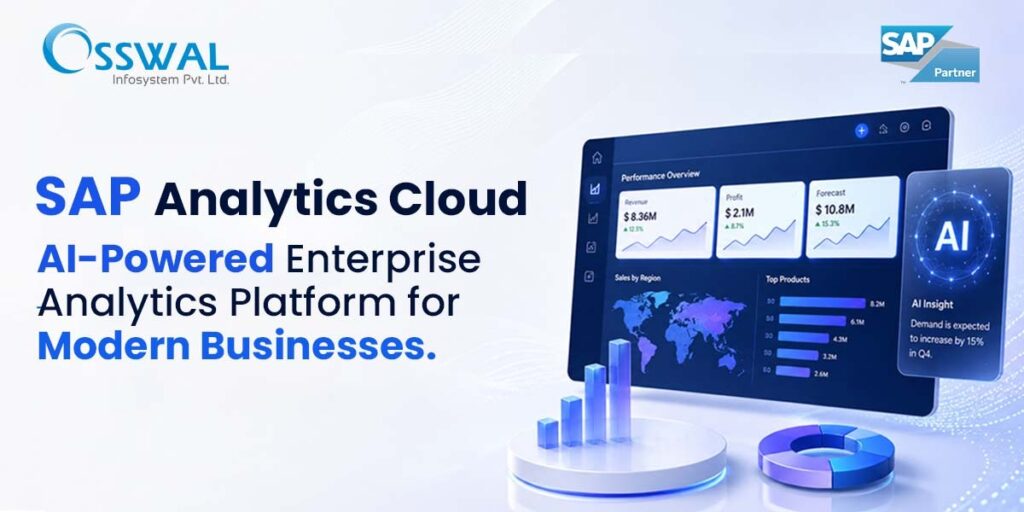
SAP Analytics Cloud: AI-Powered Enterprise Analytics Platform for Modern Businesses
SAP Analytics Cloud (SAC) is transforming how enterprises manage business intelligence, financial planning, predictive analytics, and AI-driven reporting in 2026. Companies no longer want disconnected dashboards or static reports. Instead, they need real-time analytics, intelligent forecasting, and automated business insights from a unified platform. SAC helps organizations combine analytics, planning, AI, and data visualization into one cloud-based solution that improves decision-making speed and operational efficiency.
Today, businesses are adopting AI-powered enterprise analytics because traditional BI systems cannot handle real-time forecasting, cross-functional planning, or autonomous decision intelligence. As a result, SAP Analytics Cloud is becoming a strategic platform for enterprises using SAP S/4HANA, SAP Business Technology Platform, and SAP Business Data Cloud.
What is SAP Analytics Cloud?
SAC is a cloud-based analytics and planning platform developed by SAP. It combines:
- Business Intelligence (BI)
- Predictive Analytics
- Financial Planning
- Data Visualization
- AI-Powered Insights
- Enterprise Forecasting
inside a single software environment.
Unlike traditional reporting systems, SAP Analytics Cloud integrates analytics and planning together. Therefore, companies can analyze live business data and immediately create forecasts, simulations, and strategic plans without switching between multiple platforms.
Businesses use SAC to improve:
- Financial reporting
- Supply chain planning
- Revenue forecasting
- Workforce analytics
- Executive decision-making
- Operational intelligence
Why Traditional Business Intelligence Tools Are Failing
Many organizations still depend on disconnected reporting systems and spreadsheets. However, modern enterprises need real-time intelligence instead of delayed historical reports.
Common Challenges Businesses Face
Below are the common challenges businesses face:
Data Silos Across Departments
Most enterprises store data in:
- ERP systems
- CRM platforms
- Excel files
- HR software
- Supply chain applications
As a result, teams struggle to create a unified business view.
Slow Decision-Making
Traditional BI tools mainly focus on historical data visualization. Consequently, leadership teams often react too late to changing market conditions.
Lack of AI-Driven Insights
Older analytics platforms cannot provide:
- Predictive forecasting
- Automated recommendations
- Scenario simulations
- Intelligent business context
Therefore, organizations struggle to use AI effectively for enterprise planning.
Manual Financial Planning
Finance teams still spend significant time building spreadsheets for budgeting and forecasting. In addition, manual processes increase operational risk and reduce business agility.
How SAP Analytics Cloud Solves Enterprise Analytics Challenges
SAC Creates a Unified Data Environment
SAC helps enterprises connect analytics, planning, and AI within one platform. Consequently, organizations reduce data fragmentation and improve collaboration across departments.
Teams can:
- Analyze live business data
- Create predictive forecasts
- Simulate future scenarios
- Automate planning workflows
- Monitor KPIs in real time
Because everything operates inside a centralized environment, decision-making becomes faster and more accurate.
SAP Analytics Cloud AI Features for Modern Enterprises
Artificial intelligence is now a major differentiator in enterprise analytics platforms. SAP Analytics Cloud includes several advanced AI-powered capabilities that improve forecasting and operational intelligence.
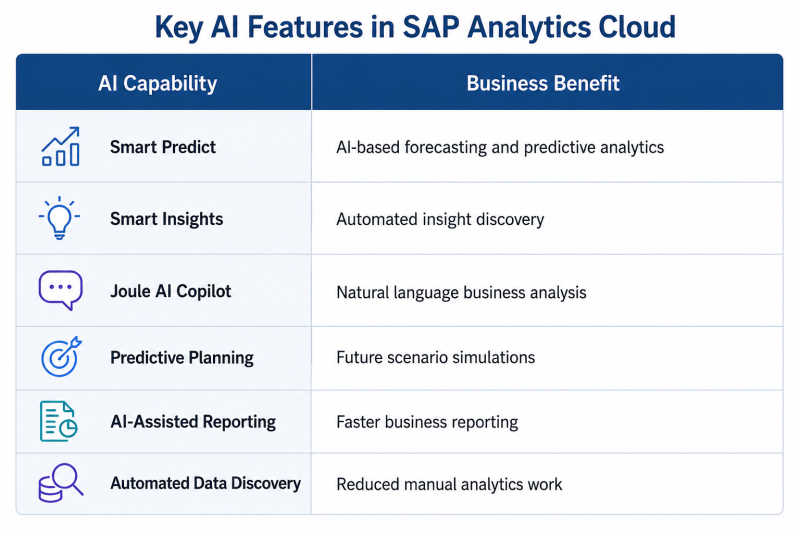
Additionally, SAP continues integrating generative AI into analytics workflows to improve enterprise automation.
How SAP Analytics Cloud Uses AI for Business Intelligence
Many enterprises now ask:
How does SAP Analytics Cloud improve business decision-making?
SAC uses AI and machine learning to automate complex analytics processes. For example, business users can ask questions like:
- Why did revenue decline last quarter?
- Which products are underperforming?
- What will next quarter’s inventory demand look like?
- Which regions are generating the highest margins?
The platform then generates contextual insights automatically.
As a result, executives no longer depend entirely on technical BI teams for strategic analysis.
SAP Analytics Cloud vs Power BI vs Tableau
Businesses frequently compare enterprise analytics platforms before implementation.
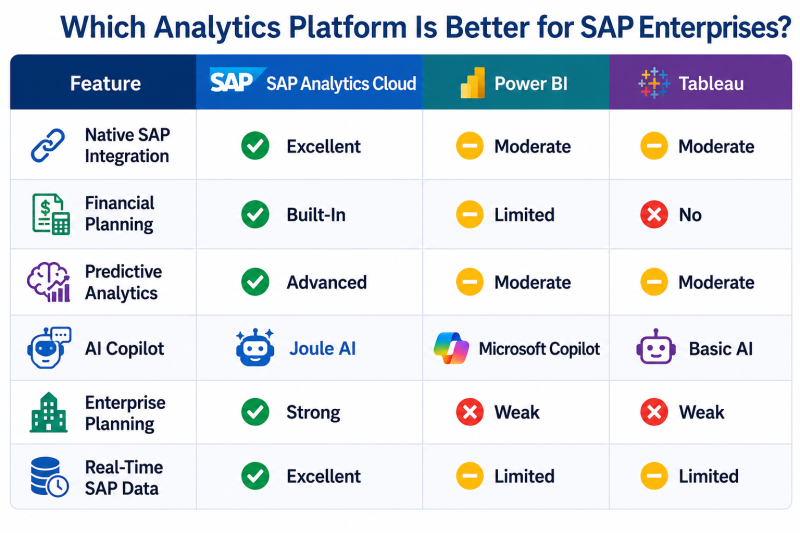
Therefore, SAP-centric organizations often prefer SAC because it preserves enterprise business context and integrates deeply with SAP ecosystems.
Advanced Business Use Cases of SAP Analytics Cloud
Below are the use cases of SAC:
Financial Forecasting and Budget Planning
Finance teams use SAP Analytics Cloud for:
- Automated budgeting
- Cash flow forecasting
- Variance analysis
- Profitability simulations
- Risk forecasting
Consequently, financial planning becomes faster and more accurate.
Supply Chain Analytics
Supply chain teams can:
- Predict inventory shortages
- Analyze supplier risks
- Simulate demand changes
- Optimize procurement planning
As a result, businesses improve operational resilience.
Workforce Planning
HR departments use predictive analytics to forecast:
- Hiring requirements
- Employee attrition
- Workforce costs
- Skill shortages
Therefore, workforce management becomes more strategic.
Benefits of Implementing SAP Analytics Cloud
Organizations adopting SAC experience several operational benefits.
Major Business Benefits
Faster Decision-Making
Real-time analytics improves executive response time.
Better Forecast Accuracy
AI-powered predictions improve planning precision.
Reduced Spreadsheet Dependency
Centralized planning reduces manual Excel-based workflows.
Improved Cross-Department Collaboration
Finance, operations, HR, and supply chain teams work from the same data environment.
Scalable Cloud Architecture
Cloud deployment improves flexibility and enterprise scalability.
Best Practices for SAP Analytics Cloud Implementation
Successful implementation requires a structured strategy.
Step-by-Step SAC Implementation Guide
Step 1: Build a Strong Data Foundation
Clean and standardized data improves analytics quality.
Step 2: Define Business KPIs Clearly
Organizations should focus on measurable business outcomes.
Step 3: Start With High-Impact Use Cases
Begin with:
- Financial forecasting
- Executive dashboards
- Supply chain analytics
before expanding further.
Step 4: Enabe AI Features Gradually
Deploy predictive analytics and AI-driven planning step by step.
Step 5: Train Business Users
User adoption is critical for maximizing ROI.
Emerging Trends in SAC for 2026
Enterprise analytics is evolving rapidly.
Autonomous Enterprise Analytics
AI systems are increasingly automating business recommendations and workflows.
Natural Language Analytics
Users can interact with analytics platforms using conversational queries instead of complex dashboards.
Extended Planning and Analysis (xP&A)
Organizations now unify:
- Finance
- HR
- Operations
- Procurement
- Supply chain planning
inside one analytics ecosystem.
Generative AI for Enterprise Planning
AI-generated forecasting and automated planning models are becoming mainstream.
Conclusion
SAP Analytics Cloud is becoming one of the most important enterprise analytics platforms for AI-driven organizations. Modern enterprises need more than static dashboards and historical reports. They require predictive intelligence, real-time planning, and AI-powered decision-making.
SAC helps businesses combine analytics, forecasting, planning, and artificial intelligence into one scalable cloud platform. Moreover, its integration with SAP ecosystems gives enterprises a major advantage in operational intelligence and business automation.
As AI adoption continues to grow, enterprises investing in intelligent analytics platforms will improve forecasting accuracy, operational agility, and long-term competitiveness.