
SAP Business One for Manufacturing: Complete Guide for SMEs in India
In today’s competitive industrial market, manufacturing companies need smarter tools to manage production, inventory, finance, sales, and customer operations. This is where SAP Business One for Manufacturing becomes a game-changing ERP solution for small and medium-sized businesses. Whether you run an automotive unit, textile factory, electronics plant, or engineering company, SAP B1 helps streamline business processes, reduce operational costs, and improve productivity through automation and real-time data insights.
Many manufacturing businesses in India still rely on spreadsheets or disconnected software systems. However, as production complexity increases, these traditional methods create delays, inventory mismatches, and financial inaccuracies. SAP Business One solves these problems with a centralized ERP platform designed specifically for growing manufacturers.
In this article, you will learn how SAP B1 works for manufacturing companies, its features, implementation process, pricing factors, benefits, comparisons, and why it is becoming one of the best ERP solutions for Indian SMEs.
What is SAP Business One?
SAP B1 is an integrated ERP software developed for small and medium enterprises (SMEs). It helps businesses manage multiple departments using a single unified platform.
For manufacturing industries, it offers:
- Production planning
- Inventory management
- Procurement management
- Supply chain tracking
- Financial accounting
- Sales and CRM
- Warehouse management
- Business analytics
Unlike traditional ERP systems that are expensive and complex, SAP Business One is affordable, scalable, and easier to implement for growing businesses.
Why Manufacturing Companies Need ERP Software
Manufacturing businesses face several operational challenges daily. Without proper ERP software, companies often struggle with:
Common Problems in Manufacturing
Below are the Common Problems in Manufacturing:
1. Inventory Mismanagement
Raw materials may go out of stock unexpectedly or excess inventory may increase holding costs.
2. Production Delays
Manual production planning often creates scheduling conflicts and delayed deliveries.
3. Lack of Real-Time Data
Business owners cannot track operations instantly, leading to slow decision-making.
4. Financial Errors
Disconnected accounting systems create invoice mismatches and reporting errors.
5. Poor Supply Chain Visibility
Manufacturers face difficulties in tracking vendors, procurement, and warehouse movement.
As a result, companies lose efficiency, productivity, and profitability.
How SAP Business One Solves Manufacturing Challenges
SAP B1 provides an all-in-one ERP system that automates manufacturing operations from procurement to final delivery.
Key Manufacturing Solutions in SAP B1
Production Planning
SAP Business One helps businesses create accurate production schedules based on demand forecasting and inventory availability.
Benefits include:
- Reduced production delays
- Better resource utilization
- Faster order completion
- Improved workflow efficiency
Inventory Management
Manufacturers can monitor inventory levels in real time.
Features include:
- Batch tracking
- Barcode integration
- Warehouse monitoring
- Stock alerts
- Material requirement planning (MRP)
This reduces wastage and improves inventory accuracy.
Bill of Materials (BOM)
SAP B1 allows businesses to create multi-level BOMs for production management.
This helps manufacturers:
- Track raw materials
- Calculate production costs
- Improve product consistency
- Manage assembly operations
Quality Control
Manufacturers can maintain product quality standards through inspection tracking and compliance monitoring.
Financial Integration
Unlike standalone manufacturing software, SAP B1 integrates accounting directly with production and sales.
This provides:
- Real-time profit analysis
- Cost tracking
- GST compliance
- Automated invoicing
- Financial transparency
Top Features of SAP Business One for Manufacturing
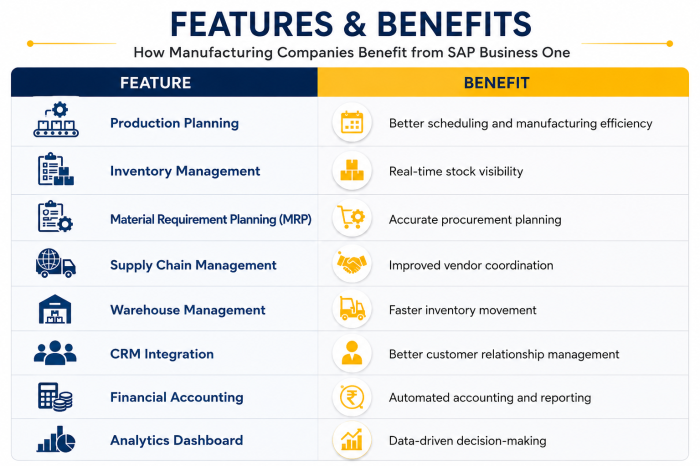
Benefits of SAP B1 for Manufacturing SMEs
Manufacturing companies choose SAP B1 because it improves operational efficiency and supports business growth.
1. Improved Productivity
Automation reduces manual work and speeds up daily operations.
2. Better Decision-Making
Real-time dashboards and analytics help management make faster business decisions.
3. Reduced Operational Costs
Efficient inventory planning and resource management lower overall costs.
4. Enhanced Customer Satisfaction
Faster production and timely deliveries improve customer relationships.
5. Scalability
As the business grows, SAP B1 can scale with additional modules and integrations.
6. Regulatory Compliance
The software helps businesses maintain GST compliance and financial reporting standards.
Industries Using SAP B1 Manufacturing Solution
SAP B1 supports multiple manufacturing industries, including:
- Automotive manufacturing
- Textile and apparel
- Food and beverage
- Pharmaceuticals
- Electronics manufacturing
- Plastic and packaging
- Engineering industries
- Chemical manufacturing
Therefore, businesses across different sectors can customize SAP B1 according to their operational needs.
SAP Business One Implementation Process
Many businesses ask, “How to implement SAP B1 for manufacturing?”
Here is a step-by-step implementation process.
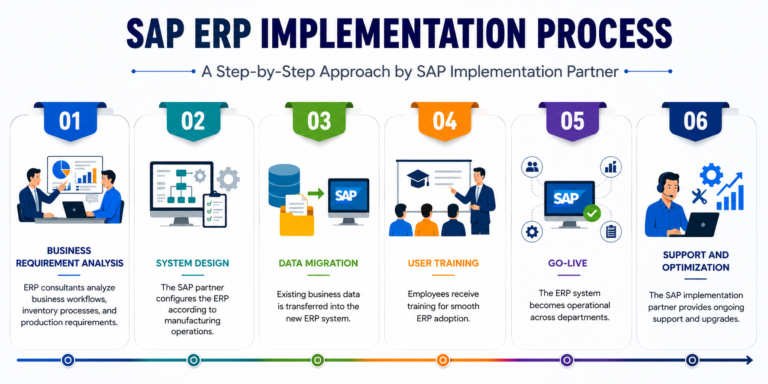
The SAP implementation partner provides ongoing support and upgrades.
A proper implementation strategy ensures minimal downtime and faster ROI.
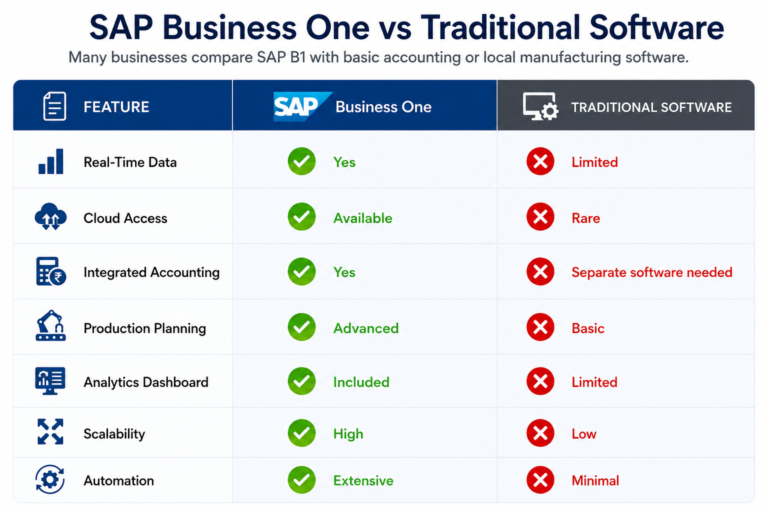
SAP Business One vs Traditional Manufacturing Software
Many businesses compare SAP B1 with basic accounting or local manufacturing software.
How Much Does SAP Business One Cost in India?
SAP B1 pricing depends on several factors, such as:
- Number of users
- Cloud or on-premise deployment
- Manufacturing modules
- Customization requirements
- Implementation complexity
Generally, pricing includes:
- Software license
- Implementation charges
- User training
- Annual maintenance
Although the initial investment may appear high, the long-term operational savings and productivity gains make it cost-effective.
Best Practices for Successful SAP Business One Implementation
To achieve better ERP success, manufacturers should follow these practices:
Choose the Right SAP Partner
A certified SAP implementation partner ensures proper deployment and support.
Define Clear Goals
Businesses should identify operational problems before implementation.
Train Employees Properly
Employee adoption plays a major role in ERP success.
Start with Core Modules
Initially implement essential modules, then expand gradually.
Monitor Performance
Track KPIs regularly to measure ERP efficiency improvements.
Future of Manufacturing with SAP Business One
The manufacturing industry is rapidly moving toward automation, AI-driven analytics, and digital transformation. Businesses that continue using outdated systems may struggle to compete in the future.
SAP B1 helps manufacturers adopt:
- Smart automation
- Real-time analytics
- Cloud ERP
- Integrated business management
- Data-driven production planning
As Industry 4.0 adoption increases, ERP solutions like SAP B1 will become essential for manufacturing growth and operational efficiency.
Conclusion
SAP Business One for Manufacturing is one of the most effective ERP solutions for SMEs looking to improve productivity, reduce costs, and streamline operations. From production planning and inventory management to accounting and analytics, SAP B1 provides a complete business management platform for growing manufacturers.
Additionally, its scalability, automation capabilities, and real-time insights make it an ideal choice for businesses preparing for digital transformation. Companies that invest in the right ERP solution today can build stronger operational efficiency and long-term competitive advantage in the manufacturing sector.
If your manufacturing business wants better visibility, improved workflow automation, and smarter decision-making, implementing SAP Business One can be a strategic step toward sustainable growth.