SAP Business One in India: A Practical Guide for Growing Businesses
Businesses in India are managing more data, customers, suppliers, inventory, and financial transactions than ever before. SAP Business One in India helps growing companies bring these processes into one connected business management system. It can support finance, sales, purchasing, inventory, customer management, and reporting from a central platform. Moreover, India-specific capabilities help businesses manage requirements such as GST and TDS more effectively.
Why Businesses Need an Integrated ERP System
Many growing businesses still depend on spreadsheets and disconnected applications. This approach can work at a smaller scale. However, it often creates duplicate data, manual work, and reporting delays as operations expand.
An ERP system connects important business functions. As a result, finance teams can access transaction data faster. Sales teams can track customer information more efficiently. Similarly, inventory teams can monitor stock and purchasing activities from a connected system.
For Indian businesses, local compliance is another important consideration. GST requirements can affect locations, business partners, items, tax codes, and transactions. Therefore, businesses need an ERP setup that supports their operational and tax processes together. SAP provides India-specific functionality for these requirements.
Key Benefits of SAP B1 in India
SAP B1 in India can help businesses create a more structured approach to daily operations. Instead of maintaining information across multiple systems, companies can centralise important processes.
One major benefit is better financial visibility. Finance teams can monitor transactions, accounts, receivables, payables, and other financial information through connected processes. This can reduce manual reconciliation work and improve access to business information.
Inventory management is another important area. Companies can track items, warehouses, purchasing, and sales activities in one environment. Consequently, management can make decisions using more consistent information.
The system can also support sales and customer processes. Teams can manage business partner information, sales documents, purchasing activities, and related records. This creates better coordination between departments.
Furthermore, reporting becomes easier when business information remains connected. Managers can review operational data and identify trends without depending entirely on manually prepared spreadsheets.
India-Specific Tax and Compliance Support
Indian businesses face specific tax and reporting requirements. Therefore, local ERP capabilities can play an important role during implementation.
SAP’s India localisation includes functionality related to GST. It supports tax types such as CGST, SGST, IGST, CessGST, and UTGST. Businesses can also configure tax determination according to relevant transaction conditions.
The system also includes location-related GST information. For example, businesses can maintain GSTIN and GST type information for locations. Correct location configuration is important because GST functionality depends on accurate setup.
In addition, the India localisation includes TDS-related functionality. This can support activities such as TDS deductions, adjustments, payments, and related reporting.
These capabilities can help companies create a more organised compliance process. However, businesses should always configure tax rules according to their current requirements and professional advice.
Choosing the Right SAP Partner in India
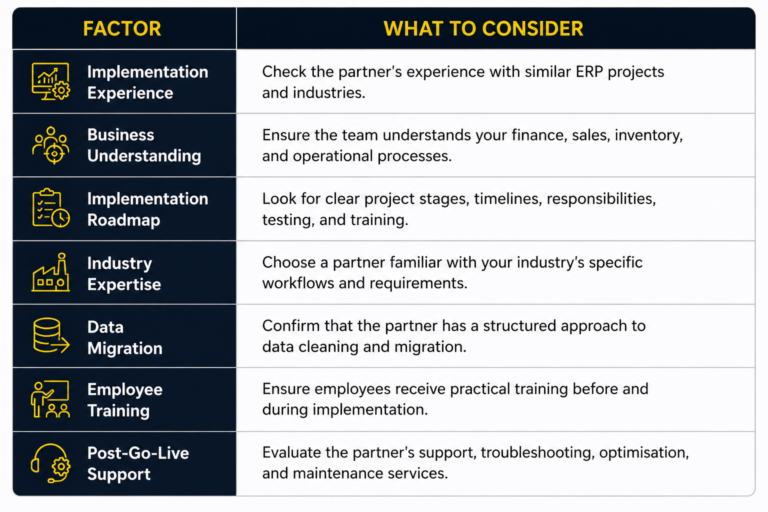
Selecting an experienced SAP partner in India is essential for successful ERP implementation. Businesses should consider the partner’s industry experience, implementation approach, technical expertise, training process, data migration capabilities, and post-go-live support. A reliable partner should understand business requirements, create a clear roadmap, and provide dependable assistance throughout implementation.
What to Look for in an SAP B1 Partner in India
Choosing an SAP B1 Partner in India requires more than comparing implementation costs. Businesses should assess the partner’s technical knowledge, consulting experience, communication process, and support model.
First, check the team’s implementation experience. Ask about previous projects, industries served, and the type of business processes handled.
Second, review the implementation methodology. A structured approach can reduce confusion during requirement gathering, configuration, testing, and deployment.
Third, consider customisation carefully. Not every business requirement needs custom development. In many cases, better process design and standard functionality can solve the requirement without unnecessary complexity.
Data migration also deserves attention. Poorly prepared master data can create problems after deployment. Therefore, the implementation team should define a clear process for cleaning, validating, and transferring relevant information.
Training is equally important. Employees should understand how their daily tasks will change after implementation. Practical training can improve adoption and reduce resistance.
How SAP B1 Supports Business Growth
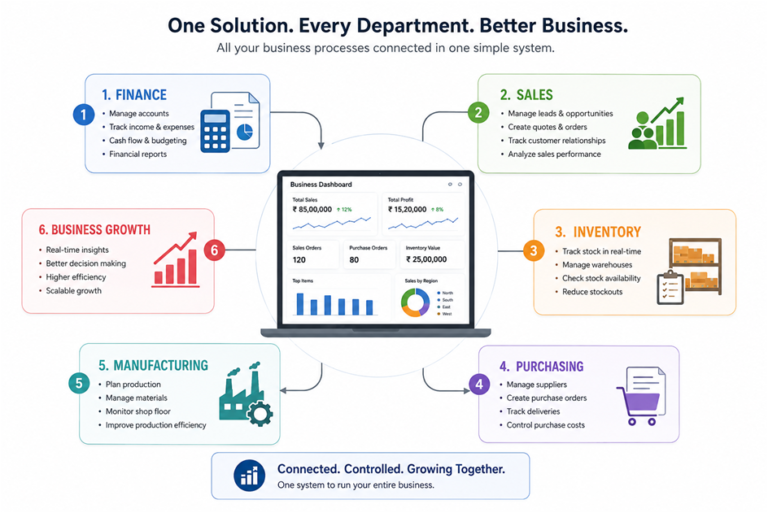
Growth brings new customers, larger transaction volumes, more products, and increasingly complex operations. Businesses therefore need an ERP system that can keep different departments connected while providing accurate information for everyday decisions. SAP B1 in India can help create this connected environment by bringing essential business processes together.
One System, Multiple Business Functions
- Streamlined Operations: Connect purchasing, inventory, sales, and finance to reduce disconnected workflows.
- Better Inventory Control: Track materials, stock movements, warehouses, and purchasing activities more efficiently.
- Improved Manufacturing Coordination: Connect production, materials, inventory, purchasing, and financial information for smoother operations.
- Faster Business Insights: Centralised data can reduce time spent collecting information manually and support quicker reporting.
- Scalable Processes: As companies expand into new products, locations, or markets, connected processes can make growth easier to manage.
Turning Data into Better Decisions
Centralised business information gives managers greater visibility across operations. Instead of relying on scattered spreadsheets, teams can analyse relevant information and identify process gaps more easily. This can improve coordination, strengthen internal control, and help businesses plan their next stage of growth with greater confidence.
Common Mistakes to Avoid During Implementation
Below are some common mistakes to avoid during implementation:
- Skipping proper requirement planning: Starting implementation without clearly documenting business requirements can lead to unnecessary changes later.
- Ignoring data quality: Treating data migration as a simple technical task can create operational issues if master data is not cleaned and validated.
- Over-customising the system: Excessive customisation can increase complexity, implementation time, and future maintenance costs.
- Leaving employees out of the process: Not involving key users during planning and testing can reduce user adoption and overlook important operational needs.
- Stopping after go-live: ERP implementation does not end at deployment. Regular support, user feedback, and system improvements are essential for long-term success.
Why the Right Implementation Approach Matters
A successful ERP project depends on people, processes, technology, and planning. SAP Partner in India selection should therefore remain part of the overall business strategy rather than a simple purchasing decision.
Companies should begin with clear objectives. These may include improving financial visibility, reducing manual work, strengthening inventory control, improving reporting, or supporting expansion.
Next, businesses should map existing processes and identify gaps. The implementation team can then determine which processes should use standard functionality and which may require controlled changes.
Testing should follow configuration and data migration. Teams should test realistic business scenarios before deployment. This approach can identify errors while there is still time to correct them.
Employee training should happen before go-live. Furthermore, companies should provide users with clear procedures and support channels during the transition.
Conclusion
Choosing the right ERP platform can help Indian businesses build stronger operational foundations. SAP Business one india can support companies that want connected finance, sales, purchasing, inventory, and reporting processes. India-specific capabilities can also help businesses manage important areas such as GST and TDS. However, successful implementation requires more than software selection. Businesses need clear requirements, clean data, effective testing, employee training, and dependable support.
The right SAP B1 Partner in India can help businesses plan each implementation stage and align the system with their operational needs. A well-planned approach can reduce manual processes, improve information visibility, and create a stronger foundation for sustainable business growth.
Also Read: SAP Business One For Indian SMEs: Features, GST and Benefits