
SAP Business One in Indore: An ERP Guide for Growing Businesses
Indore has become a strong commercial centre for manufacturing, trading, food processing, engineering, pharmaceuticals, distribution and professional services. As these businesses grow, spreadsheets and disconnected applications often create delays in purchasing, inventory, sales and finance. SAP Business One in Indore gives growing companies a way to connect these functions through one ERP environment while keeping processes practical for mid-sized operations.
Why Indore Businesses Need a Connected ERP
A connected ERP changes how departments share information. For example, when a sales order is entered, the business can check available stock, review customer credit information and plan procurement without moving information between several systems.
This becomes particularly useful for companies dealing with:
- Multiple warehouses or branches
- Fast-moving inventory
- Batch or serial-number tracking
- Purchase orders linked to production or sales
- Credit-based customer sales
- Frequent stock transfers
- GST-related transactions
- Approval-driven purchasing and expenses
What SAP Business One in Indore Can Improve
SAP B1 In Indore can support businesses that want stronger control without building an ERP process from scratch. The value comes from connecting day-to-day activities rather than simply digitising existing paperwork.
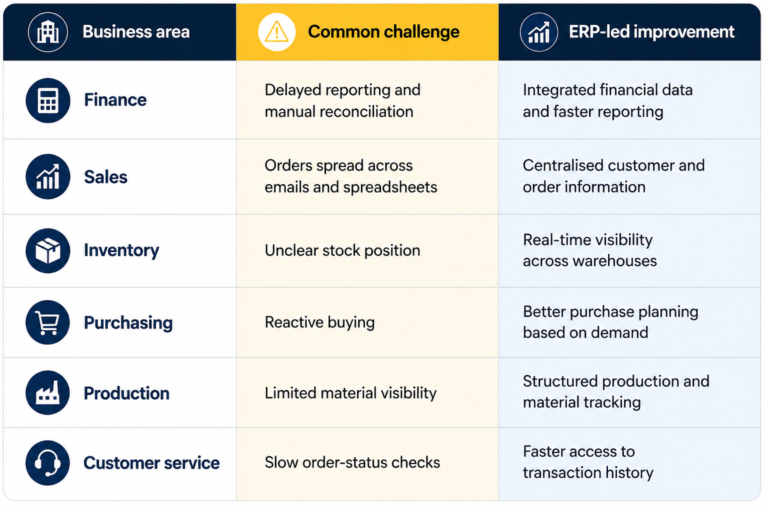
For an SAP B1 In Indore project, the priority should be practical workflows. For a distributor, this can mean knowing which warehouse has an item before promising a delivery. For a manufacturer, it can mean linking material requirements with production planning. For a service business, it can mean keeping customer, billing and payment information in one operational view.
Key Modules for Indian Mid-Sized Companies
For SAP Business One in Indore, an ERP project should begin with business processes, not a list of software features. The right module mix depends on how a company sells, purchases, stores and produces goods.
Financial Management
Finance teams can manage accounting transactions, receivables, payables, cash flow and reporting from a connected system. This reduces the need to collect figures from separate departments at month-end.
Sales and Customer Management
Sales teams can maintain quotations, orders, deliveries, invoices and customer records in a common workflow. Managers can also review sales performance using structured information instead of manually combining reports.
Purchasing
Purchase teams can track quotations, purchase orders, goods receipts and supplier invoices. Approval workflows can add control when businesses want spending to follow defined authority levels.
Inventory and Warehouse Control
Inventory becomes more manageable when item masters, warehouses, batches, serial numbers and stock movements follow consistent rules. This is particularly useful for distributors and manufacturers where stock accuracy directly affects customer service.
Production and Planning
Manufacturing companies can use bills of materials, production orders and material planning to bring more structure to shop-floor requirements. This helps teams connect what they need to produce with the materials they need to procure.
How a Local ERP Implementation Should Work
The project should map the company’s existing workflows and identify where controls or automation can create measurable gains. A practical implementation sequence looks like this:
- Process discovery: Document sales, purchase, inventory, finance and production workflows.
- Gap analysis: Identify duplicate work, approval gaps, reporting delays and data-quality issues.
- Solution design: Configure workflows, master data, roles, reports and required integrations.
- Data preparation: Clean customer, supplier, item, opening balance and inventory information.
- Testing: Run realistic purchase-to-payment, order-to-cash and inventory scenarios.
- User training: Train employees according to their actual roles instead of giving everyone the same generic session.
- Go-live support: Monitor transactions, reports and user issues during the early operating period.
- Post-go-live improvement: Review adoption and refine reports, authorisations and processes.
This approach reduces the risk of implementing an ERP that technically works but does not fit the way people actually work.
Choosing the Right SAP Partner in Indore
When evaluating an SAP Business One Partner in Indore, businesses should look beyond implementation experience alone. A strong SAP Business One Partner in Indore should understand the company’s industry, transaction volumes, reporting requirements and existing technology landscape.
Before selecting a partner, ask:
- Have they handled businesses with similar inventory or production complexity?
- Can they demonstrate a complete business process rather than isolated screens?
- How will they migrate and clean existing data?
- What reports and dashboards will be configured?
- How will user roles and approval rules be designed?
- What support will be available after go-live?
- Can they integrate existing applications where necessary?
The best fit is usually an SAP Business One ERP Partner in Indore that can translate business problems into practical ERP workflows.
Industry-Specific Use Cases in Indore
Indore’s diverse business base means the same ERP configuration will not suit every company. A food manufacturer may need batch tracking and expiry controls, while an engineering company may focus on bills of materials and production planning.
For example:
Food and FMCG: Track batches, expiry dates, purchases, warehouse stock and customer orders.
Engineering and manufacturing: Connect bills of materials, production orders, material requirements and inventory.
Pharmaceutical businesses: Strengthen batch-level visibility, purchasing controls and transaction traceability.
Trading and distribution: Monitor stock across warehouses, customer credit, order fulfilment and receivables.
Professional services: Improve customer records, billing workflows, expense control and management reporting.
What to Check Before Going Live
Before launch, management should test the system using actual business scenarios. A successful demo is not enough. The team should confirm that daily transactions, controls and reports work as expected.
Use this checklist:
- Customer and supplier masters are clean.
- Item codes follow a consistent naming structure.
- GST and tax settings are validated.
- Opening balances have been reconciled.
- Warehouse locations are correctly mapped.
- Approval workflows match management authority.
- User access reflects job responsibilities.
- Critical reports have been tested.
- Backup and support procedures are documented.
These checks can prevent small configuration issues from becoming major operational problems after go-live.
Understanding the Cost of ERP Ownership
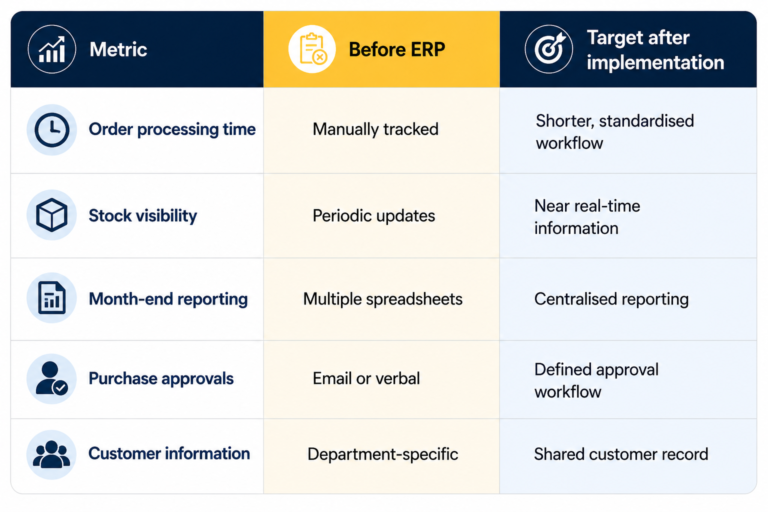
Companies often focus on licence or implementation cost alone. However, the real business case should include data preparation, training, integrations, support, custom reports and future process changes.
A useful evaluation compares the expected investment with measurable outcomes such as:
Finding the Right ERP Fit
A search for SAP Business One Near Me should not end with the closest provider. Location can make communication easier, but industry knowledge, implementation methodology and post-go-live support are more important selection factors.
If you search SAP Business One Near Me, consider the provider’s ability to understand your processes, not just its physical location. For businesses comparing an SAP Business One ERP Partner in Indore, the right questions should focus on outcomes. Can the partner reduce manual work? Can it improve inventory visibility? Can management receive reliable reports? Can employees adopt the system without excessive complexity?
Conclusion
SAP Business One in Indore can be valuable when it is implemented around real business processes rather than treated as a simple accounting or billing application. For growing companies, the bigger opportunity is to connect finance, sales, purchasing, inventory and production so that teams work from consistent information.
Before starting, map the processes that currently consume the most time. Then define measurable goals, clean your master data and select an implementation team that understands your operational needs. With the right preparation, SAP Business One in Indore can become a practical foundation for controlled growth, better visibility and faster decision-making.
Frequently Asked Questions (FAQs)
SAP Business One helps growing businesses manage finance, sales, purchasing, inventory, production and customer information through one integrated ERP system.
Manufacturing, pharmaceuticals, food processing, trading, distribution, engineering and other growing businesses can use it to improve operational control and reporting.
Look for a partner with relevant industry experience, a clear implementation methodology, strong training, data-migration capabilities and reliable post-go-live support.
Yes. Businesses can manage inventory across multiple warehouses, monitor stock movements and improve visibility of available quantities across locations.
The timeline depends on business size, modules, data complexity, integrations and customisation requirements. A detailed process assessment is needed before estimating the project duration.