

Uncategorized

SAP Business One can have a positive impact on your business, especially when you are ready to start expanding. 1. Low-cost large-scale solution The operational requirements of many small businesses are as complex as those of large organizations. The great thing about SAP Business One is that you can access the same type of enterprise resource planning (ERP) system used by multinational companies without paying a high price. SAP provides the same types of tools in integrated solutions-business intelligence and analysis, sales forecasting and management, and customer relationship management. 2. Higher financial visibility Automate daily accounting tasks, such as general ledger and daily account maintenance, tax calculations, and enabling transactions in different currencies. SAP Business One can easily analyze financial information. Companies can easily manage their cost center structure hierarchically to obtain clear and accurate reports. Users can configure the budget allocation method, define the budget number in any currency, and display a summary budget report that compares the actual number with the planned number. SAP Business One provides functions to create business, accounting, warehouse, and financial reports, account statements, and custom reports. Reports can be exported in different formats, including Microsoft Excel, Word, and PDF. 3. Improve supply chain management The inventory function of SAP Business Ones enables users to accurately manage inbound and outbound shipments, material master information, and price lists. Users can define alternative items, adjust them up and down, and re-evaluate inventory costs based on current market values. This function allows users to define production materials (manufacturing), purchase materials (purchase), or materials not in inventory, including labor, travel or fixed assets. Serial numbers can be automatically generated based on templates. Users can assign batches to products and classify them by shelf life or any other attributes. Uses an inventory valuation method to maintain reports, and users can easily select items from the list and change the current valuation method to an alternative method. You can define multiple levels of storage boxes in the warehouse, which will allow you to store goods in a single storage box. You can configure these storage bins with your own parameters, restrictions, and requirements. In a department store, inventory counting is usually a continuous process. This function speeds up processing by determining when each inventory item should be counted.Users can define any number of price lists and link them to customers or suppliers. This function allows users to manage the sorting and packaging process in three queues. After the sales orders are entered, they will be displayed in the “open” queue and can be released for picking before delivery. 4. Better forecast customer needsClosely integrates your sales and customer relationship management functions. Track the progress from the beginning of the transaction to the end of the transaction, and improve pipeline accuracy. Once your potential customers become customers, you can manage all customer relationships and marketing activities through one platform. Centralizing all data in one place enables you to build more effective services and communication programs. 5。 Industry Best ImplementationNo matter which industry you are in, SAP Business One can immediately provide you with a best practice system. This solution can be tailored for your wholesale, manufacturing, construction, or distribution business. Compared with other solutions on the market, its implementation speed is quite fast. 6。 Improve decision-makingTo create and customize all the reports required to make you greater confidence in the decision-making. You can configure settings and report data that is important to you and can support more agile decision-making methods. 7。 Easy-to-access trainingSAP has invested a lot in online training and user assistance, so you can easily get your team and new employees to get started quickly. In leverage technology, we also provide you with free training and additional content, such as commentary seminars and webinars. Osswal Infosystem has the experts needed to manage and implement SAP to provide the best ERP solution, so you don’t have to worry about process modernization. SAP Business One partner is known for helping companies make the most of ERP services to enhance profitability and functionality and thereby increase revenue. Osswal Infosystem will help you make full use of SAP B1 software to help you make decisions based on instant information. We provide one-click SAP installation for your business.

SAP Business One can bring real benefits to small & medium businesses Read More »

What is ERP Software and Why is required for Our Business? ERP Software ERP stands for enterprise resource planning, it makes business more profitable and provides a level of control unrivaled by utilizing ERP you become smarter and strategic decisions become more fluid and easier to make. What exactly is ERP? Weknow it means enterprise resource planning but what is its real purpose? ERP is an umbrella term for a complicated type of software setup. ERP can be very simple once you understand its purpose and the depth involved. So let’s take a look at that now and it really can help your business grow and connect better it can be customized and tailored to your needs. Your business is unique and has individual requirements that need specific software solutions. When you roll out an ERP system you open up access to task management human resources, fleet management bills, expense management, purchase orders, project management, invoicing, stock management, and quotes asset management. Now let’s say you have a warehouse this warehouse stocks all of your products. When a product is ordered, ERP will be involved in every part of the cycle it will automatically schedule delivery and arrange who should prepare the product then provide monitoring and transit through fleet management and even replenish that product all automatically fill. Why is required Would your brain be as powerful in controlling your body’s different parts? If it had no information on their strengths, weaknesses, and abilities. An enterprise resource planning system is similar to the brain as it integrates different departments across a company in a centralized manner. It enables agility by connecting information from everyone, every department, and every process throughout the entire enterprise, and this means seamless communication full picture of your valuable resources and eventually confident business decision. ERP is controlling and coordinating every part of your business, from quotation to delivery and invoicing. Provide you with the full information necessary for effectively manage your business processes. ERP helps in areas like inventory management, productions, sales, HR, accounts, and several other business processes. With a fully web-based application, you can work from anywhere on any device and cooperate in real-time with the latest data at your fingertips. Markets change fast. You need to know where you are now today because it is the time to do business better.

What is ERP Software and Why is required for Our Business? Read More »

Digitalization is the conversion of analog (paper-based processes) into business processes that leverage cloud technology innovation. Digital Transformation is the use of new, fast, and frequently changing digital technology to solve problems. It is the driving force of modern businesses. It encourages paperless transactions, informed decisions, and real-time working. Technologies such as Blockchain, the Internet of Things, Artificial Intelligence, Machine Learning, Cloud, etc. are all contributing to the digital transformation process. These are the services that enable Industry 4.0 and encourage real-time, error-free, and streamlined work. Transformative technologies are drastically changing the way businesses interact, innovate and gain valuable insights. They give organizations the agility to sustain and embrace state-of-the-art technologies which can drive innovation. The January 2020 survey, “Streamlining Financial Processes in the Cloud,” found that almost 60% of finance professional survey respondents identified manual processes as their top pain point, and view ERP as the most relevant infrastructure for managing and automating financial processes. Extensive range of features that add value to many embedded business processes. SAP Business One drives new kinds of business value.

What is Digital Transformation? Read More »

An ERP software helps your business ensure numerous benefits, the first being automation. Check out the other advantages, apart from it, below: Streamlined processes: An ERP system integrates all the processes across departments from beginning to end and meets the specific needs of each individual business. Improved productivity & efficiency: An ERP system saves time and resources by automating manual business tasks and processes to promote productivity and improve efficiency. 82 percent* companies that implemented an ERP solution improved either key or all business processes post implementation. Enhanced business visibility: With the integration of all the business processes, ERP gives management comprehensive and real-time visibility into performance of each department and access to key business data. Quality analysis & reporting: An ERP software allows business managers to use interconnected dashboards to quickly analyze & report, thus facilitating informed and accurate decision making. Reduced costs & risks: Uniform and streamlined business processes reduce the operational and management costs while improved data integrity and financial control reduce risks. Industry & regulatory compliance: An ERP solution facilitates control over reporting processes and thus ensures compliance with regulatory requirements, meeting data integrity and enabling complete traceability, thereby keeping away hefty fines and image damage. Studies reveal that 54 percent of the organizations that got the ERP implementation done were very satisfied with the overall ERP vendor experience. Further, 57 percent of the companies who got the ERP implementation done viewed it as a success. This should give you a clear picture as to how beneficial ERP is to the success of businesses. SAP Business One helps you to streamline processes, act on timely information, and drive profitable growth It captures all critical business information for immediate access and use company wide.

Why ERP? Read More »

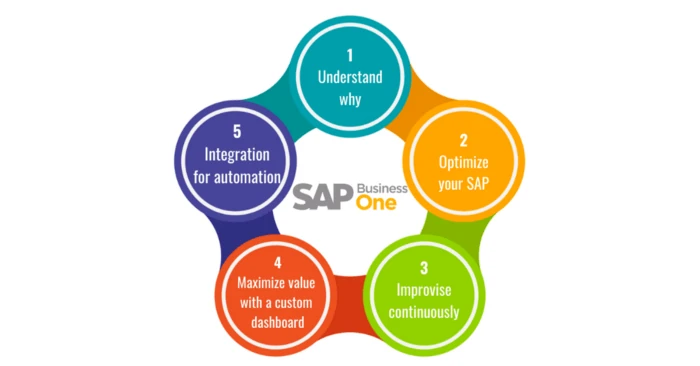
Gaining an understanding of why you need SAP for your business and the purpose it is going to fulfill for you is essential. Any ERP is typically designed to handle the management of materials, inventory control, supply chain, purchasing, finance, and accounting. So, you must be able to clearly define the way you are using SAP ERP system. The answers will facilitate the growth of your business and help you beat competition using SAP. Make it mandatory to derive the goals you can achieve with SAP ERP. • Optimize your SAP In order to transform your business using ERP, you must make time to streamline and change the processes it supports. Look at how you can handle each of the aspects handled by the ERP. For instance, understanding how you can optimize your inventory with an endless aisle can help. Optimize your SAP based on the needs of different departments to maintain a free flow of the process across the organization. Work towards achieving a common ground with all the departments to organize the workflows. Organized workflows reduce the turnaround time for many business processes. • Improvise continuously Continuously updating and adjusting the ERP in alignment with the business goals can be useful. It is not a stagnant process and needs updates on a regular basis. Have an annual budget and review plan in place. By updating your ERP software on regular basis, you can gain insights into the business processes. You can leverage the ERP to its full potential with little improvisations. • Maximize value with a custom dashboard Customize your SAP based on the users in different functional areas. Make an analysis of which tools will cater to which teams. This will enable you to provide only those features and tools to those respective teams. For example, the production team will need a different set of tools when compared to the accounting team. Create custom dashboards to address the needs of individual teams. All the teams can use the same system but should have interface personalized to serve them. If the SAP interface is customized for users, providing the most relevant information, the right information reaches the right people. Now, align it with custom reports and you can leverage this data to set actionable business goals. • Integration for automation Lastly, you can make your SAP ERP effective by integrating it with your e-commerce platform, Machines, Websites, Mobile Apps. There are many challenges SAP B1 integration can address for you. Integration helps in the seamless mapping of data across systems. You can address the following aspects for your e-store with the help of integration. SAP Business One helps you to streamline processes, act on timely information, and drive profitable growth It captures all critical business information for immediate access and use company wide.

Ways to increase the effectiveness of SAP ERP system Read More »

SAP Partner evaluation is a step-by-step process. Once you shortlist the partners based on certain criteria such as your business needs, controls, etc., you can evaluate them in a lot of different ways. You can gather information from outside sources like the clients that partner is currently serving, or has served in the past. Once you are sure about the partner, you can invite him for a demo session, where you can assess him on different parameters such as industry and technical expertise, functional knowledge, expertise in project management, background check, ability to deliver the implementation on time, keeping the budget, having required tools and resources to fulfill the needs of the implementation, long-term support post implementation, future development roadmap, Total Cost of Ownership (TCO), including, license fees (including third party), implementation fees (training and consulting), support, hardware/software and maintenance fees, so on and so forth.  

How I choose my SAP Partner? Read More »